How to Improve Your Leadership Effectiveness Through Insight
A Review of Tasha Eurich’s Insight
Is Introspection the Road to Self-Awareness?
What do you picture in your mind when you think of someone practicing “introspection”?
Maybe a monk on a mountaintop, a hippie gazing at her navel, or an executive trying to quiet the noise?

Done correctly, these may be good ways to gain insight, but organizational psychologist, executive coach, and author Tasha Eurich argues that we often get the idea of useful introspection wrong. In one study conducted by her team, people who regularly engaged in self-reflection reported more stress, lower satisfaction with jobs and relationships, and less sense of control over their lives. The distinction matters: self-reflection does not automatically produce greater insight.
In leadership coaching I have done with Maersk Training, we started with the concept of “Leading Self.” Before we can lead others effectively, we need to develop self-awareness and understand how our behavior affects the people around us. Tasha Eurich’s book Insight: The Surprising Truth About How Others See Us, How We See Ourselves, and Why the Answers Matter More Than We Think provides an in-depth and practical resource for developing that insight.
What do we mean by this often-used word “self-awareness”? Eurich attempts to nail down this nebulous concept with her own definition:
“Self-awareness: The will and the skill to understand who we are,
including things like our values, patterns, and impact on others (internal self-awareness) and how others see us (external self-awareness).”
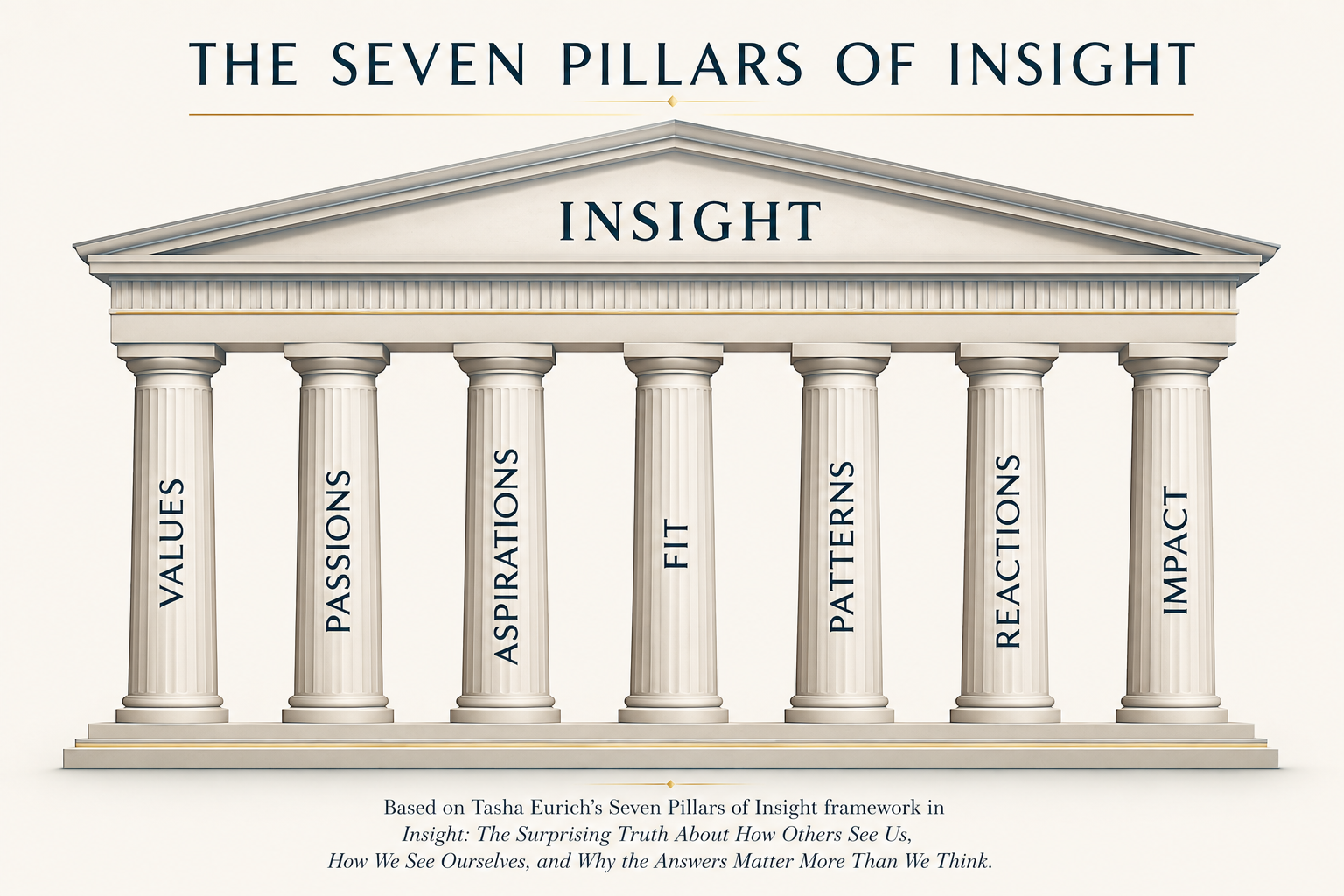
In chapter two she further breaks down self-awareness by presenting Seven Pillars of Insight:
Values (guiding principles)
Passions (activities that excite us)
Aspirations (things we strive to achieve or be)
Fit (the environment that keeps us happy and engaged)
Patterns (our consistent thoughts, emotions, and behaviors)
Reactions (those thoughts, emotions, and behaviors that reveal our strengths and weaknesses)
Impact (the effect we have on others)
Insight’s Organization
Eurich divides her work into four parts:
Roadblocks and Building Blocks
Introduces the Seven Pillars of Insight
Discusses events that lead to new insights
Points out “blindspots” and cognitive errors preventing insight
Shows how the “cult of self” hinders insight
Internal Self-Awareness: Myths and Truths
Shows how most people ineffectively do introspection
Suggests how to properly introspect
Gives techniques to escape self-destructive rumination
Suggests self-awareness tools
External Self-Awareness: Myths and Truths
Discusses the difficulties in getting honest feedback
Suggests tools for gathering useful feedback
Describes four types of feedback
Provides tools for properly responding to surprising or difficult feedback
The Bigger Picture
Applies insight on an organizational/collective level
Provides tools for building self-aware teams
Suggests methods for dealing with people who are not self-aware
The book flows smoothly and is very well organized, with bullet summaries at the end of each chapter and an extensive appendix of questionnaires and other tools for putting its principles into practice. Although it cites hundreds of scientific studies, books, and articles, it is written for ordinary readers rather than academics.
How Did Tasha Get Insight into Insight?
One problem with studies attempting to understand self-awareness is that they often rely on self-reporting. In Eurich’s research program, 95% of participants believed they were self-aware, while she estimates that only about 10–15% met her team’s criteria for self-awareness. Her team therefore sought a select group of people who met two useful criteria for studying how self-awareness can improve:
People who were highly self-aware, but …
…who had not started out that way.
Using a multi-rater self-awareness assessment and additional screening criteria, she and her team identified 50 “self-awareness unicorns” who rated themselves highly and were also rated highly by people who knew them. She then conducted in-depth interviews with these subjects to look for patterns in how they had developed greater self-awareness. This combination of quantitative assessment and qualitative interviews gives the book a useful exploratory foundation for many of its practical recommendations.
Understanding Internal and External Self-Awareness
One of the key points in Eurich’s book is the importance of both internal and external self-awareness. Even if introspection helps us understand ourselves, we still need to understand the reactions our behavior causes and the impact we have on others. Later research broadly supports the value of considering both inward and interpersonal dimensions of self-awareness, although researchers continue to use differing definitions and some distinguish additional social dimensions. Eurich recommends a method called “Zoom In, Zoom Out,” which she attributes to psychologist Richard Weissbourd. In exchanges with others, especially when emotions run high, it’s helpful to zoom in on our own perspective to see what things are influencing our current behavior (i.e. hunger, tiredness, previous bad experience, etc.). Then we zoom out to walk in the other person’s shoes—looking at the issue from her perspective.
One way to improve self-awareness might come from the practice of Naikan. Naikan literally means “looking inside.” Though not mentioned in Eurich’s book, author and philosopher Gregg Krech presents the Japanese Naikan practice through three “life-changing questions” that can take us a long way on the journey to understanding our impact on others. Krech’s book Naikan: Gratitude, Grace, and the Japanese Art of Self-Reflection elaborates on how to get the most out of asking:
What have I received from (person x)?
What have I given to (person x)?
What troubles and difficulties have I caused to (person x)?
The method increases insight by examining our relationships and obligations to others. Asking these simple questions regularly can lead to useful discoveries about our own conduct and ways to improve our relationships.
I have found the practice useful in reminding myself how much I owe to others, and of the positive or negative impact I have on them. In fact, I have shared the spirit of the practice with my young grandsons, using a card of “Kindness Questions” based on Naikan-inspired self-reflection. It creates a way to start a more meaningful conversation—without sounding like a lecture—much better than simply asking, “What did you do today?”

Start With What, Not Why
In her TED talk, Eurich emphasizes avoiding the rabbit hole of asking “why” things happen. “Why did I not get that promotion?” “Why did she not agree to a second date?” “Why do I feel so upset with this guy?” Instead, she found that the “unicorns” focused on more concrete and specific “what” questions. “What can I do to increase my chances of making the next promotion?” “What can I do to make myself more attractive and likeable on dates?” “What are the behaviors or ideas that trigger my negative reactions?”
Space for Mindfulness
Even when introspection becomes too self-focused, overly analytical, or sinks into unproductive rumination, Eurich still emphasizes the importance of mindfulness in developing self-awareness. The distinction is important: reflection itself is not the problem; unproductive self-focused rumination is. She defines mindfulness as “simply noticing what we’re thinking, feeling, and doing without judgment or reaction.” The book offers several “non-meditative mindfulness tools,” including reframing and comparing and contrasting. I think the most helpful might be some version of her daily check-in, which is a short review of lessons learned over the day.
As a pilot of multi-crew tanker aircraft, I often flew long missions that included hours of pre-flight planning and briefings. As tired as my crew was at the end of a long day, we never skipped our “debrief” session to review what went well, what could have gone better, and what needed to be fixed before the next flight. Such reviews were key to improving our crew’s performance and safety. If we “mindlessly” went home and showed up for the next flight without thoughtfully considering lessons learned, we would be well below our potential for improvement. Mindfully considering our actions on a regular basis, drawing out lessons and action items to reach our next level of performance, builds internal self-awareness.

Pilot debriefings turn experience into learning by requiring team members to examine both their own performance and their impact on others.
Thanks for the Feedback
Insight’s third part, External Self-Awareness: Myths and Truths, focuses on how to get candid feedback, and what to do with it once we get it. Soliciting straightforward, useful feedback is not an easy thing. The people closest to us, and even relative strangers, are probably reluctant to say anything critical, in fear of creating tension. At the same time, we’re often not excited to go and get negative feedback, or “constructive criticism.” Eurich calls this the “Ostrich Trinity”:
I don’t need to ask for feedback
I shouldn’t ask for feedback
I don’t want to ask for feedback
In the Leading Maersk program in which I coached, a key element of learning for participants came from 360-degree feedback, one of the tools Eurich recommends for gaining external self-awareness. This evaluation from peers, colleagues, subordinates, and one or more layers of bosses is widely used in modern organizations, and for good reason. The Leading Maersk participants found insights into their strengths and weaknesses that were often surprising and helpful for planning self-improvement.

Eurich also offers her own RIGHT Feedback Process as another self-awareness tool. To get the most effective results, this process looks for the right people, who we ask the right questions, using the right process to “get the kind of valuable information that leads to actionable insight.” The right people are “loving critics: people who will be honest with us while still having our best interests at heart.” The right questions are ones that are specific, so that they can lead to action. The right process consists of the measurable actions one takes in response to feedback.
Eurich prescribes a “3R Model” for getting the most from feedback: receiving, reflecting on, and responding to feedback. Reflecting on the feedback involves asking three questions:
Do I understand the feedback?
How will it affect my long-term success and well-being?
Do I want to act on the feedback, and if so, how?
The last question points out that not all feedback is worth responding to. Sensitive to detrimental effects of negative feedback, Eurich advises the reader to keep a positive attitude with self-affirming tools.
While Insight makes a convincing case for the importance of feedback and offers several useful tools, authors Douglas Stone and Sheila Heen provide a much more in-depth resource for making the most of feedback in developing external self-awareness. In their work (with an even longer subtitle!), Thanks for the Feedback: The Science and Art of Receiving Feedback Well—even when it is off base, unfair, poorly delivered, and, frankly, you’re not in the mood, the authors dive into triggers that block feedback (Truth, Relationship, and Identity Triggers), and then give detailed advice on navigating feedback conversations with actionable results. Stone and Heen’s book is a worthwhile resource for getting more insight out of feedback.
Beyond Self-Awareness to Collective-Awareness
Insight’s final part steps beyond Eurich’s individual self-awareness research and applies the concept to teams. Although this section feels somewhat less connected to the earlier research, it nonetheless provides useful material for leaders and team-development activities. Eurich proposes “Five Cornerstones of Collective Insight” that a “self-aware team” needs to address:
The collective objectives
Measurement of progress to the objectives
Awareness of the means—the process—by which they’re getting to the objectives
Awareness of the assumptions being made about the business and environment and their match with reality
Understanding of the individual contributions to the team’s performance
To build these cornerstones, Eurich proposes “Three Building Blocks”:
A leader who models the way
Psychological safety
An ongoing commitment and process to remain self-aware
The author pulls from her executive coaching experience to provide multiple examples of exercises and activities that she runs to construct the building blocks, all with consultant-speak titles such as “Leader Feedback Process,” “Peer Pirate,” “Candor Challenge,” “Team Feedback Exchange,” and “Accountability Conversations.”
Delusions of Grandeur
Chapter 10 turns to a somewhat tangential but useful problem: dealing with people whose lack of self-awareness leaves their view of themselves sharply at odds with how others experience them. Eurich classifies unaware individuals into three categories: the “Lost Cause,” the “Aware Don’t Care,” and the “Nudgable.” She then suggests ways to deal with each category by accepting what can’t be changed, controlling our own reactions, and “confronting with compassion.” The book concludes with a “7-Day Insight Challenge,” followed by a substantial collection of self-assessment questionnaires and other resources.
The Meta-Skill of Self-Awareness
Insight is one of the more practical self-help, leadership, and team-development books that I’ve read. It can spark a thoughtful self-conversation for the reader. It’s certainly helpful to realize that not all “introspection” is worthwhile, and that the path to self-awareness doesn’t require climbing up to mountain monasteries or spending hours in cellphone-free silence. The breakdown into internal and external self-awareness helps one focus and balance. If you’re interested in developing your human performance skills, including the ability to lead yourself and others, self-awareness is a meta-skill that strengthens many other capabilities. It helps us reflect more accurately on experience, seek useful feedback, adjust our behavior, and understand our impact on other people. I recommend this book as a thoughtful and practical part of that journey.
The Soft Power Skills Connection
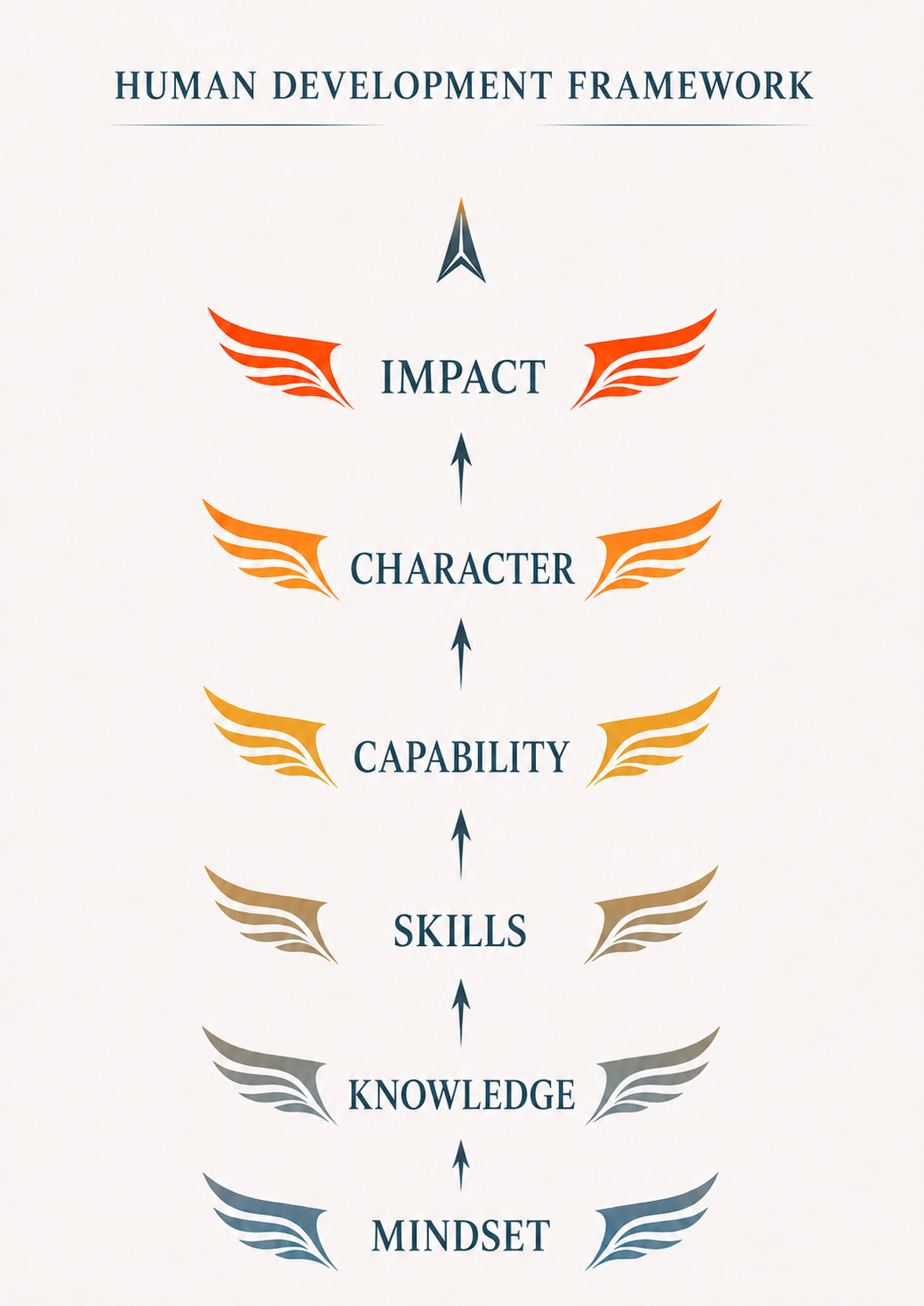
Self-awareness sits close to the beginning of human development because it improves our ability to learn from everything that follows. Reflection helps us turn experience into understanding; feedback helps us see what we cannot see for ourselves; and awareness of our impact helps us make more purposeful choices about how we lead and work with others.
In the Soft Power Skills Human Development Framework, these ideas connect most directly with Mindset, Character, and Impact. They also reinforce the Experiential Learning Cycle: experience becomes more valuable when we reflect on it, understand what happened, adapt, and apply what we learned.
Sources & Notes
Tasha Eurich, Insight: The Surprising Truth About How Others See Us, How We See Ourselves, and Why the Answers Matter More Than We Think. Penguin Random House. Primary source for the book concepts, quotations, named models, and chapter structure.
Tasha Eurich, “The right way to be introspective (yes, there’s a wrong way).” TED Ideas. Eurich’s account of her team’s self-reflection findings and the 50 “self-awareness unicorns.”
Anthony M. Grant, John Franklin, and Peter Langford, “The Self-Reflection and Insight Scale: A New Measure of Private Self-Consciousness.” Social Behavior and Personality. Peer-reviewed evidence distinguishing self-reflection from insight and relating the constructs to stress, anxiety, depression, and self-regulation.
Tasha Eurich, “What Self-Awareness Really Is (and How to Cultivate It).” Harvard Business Review, January 4, 2018. Source for Eurich’s widely cited 95%/10–15% self-awareness figures, which should be understood as findings from her research program.
Tasha Eurich, “Increase your self-awareness with one simple fix.” TED. Context for the “what, not why” discussion.
Carden, Jones, and Passmore, systematic review of self-awareness. Journal of Management Education. Later scholarship supporting inward/interpersonal dimensions while documenting differing definitions and measurement approaches.
“Developing Self-Awareness.” Annual Review of Organizational Psychology and Organizational Behavior. Recent scholarly review recognizing internal and external components of self-awareness.
Gregg Krech, Naikan: Gratitude, Grace, and the Japanese Art of Self-Reflection. Stone Bridge Press. Authoritative publisher source for Krech’s presentation of the Japanese Naikan practice.
Douglas Stone and Sheila Heen, Thanks for the Feedback. Penguin Random House. Supporting resource for receiving and using feedback.